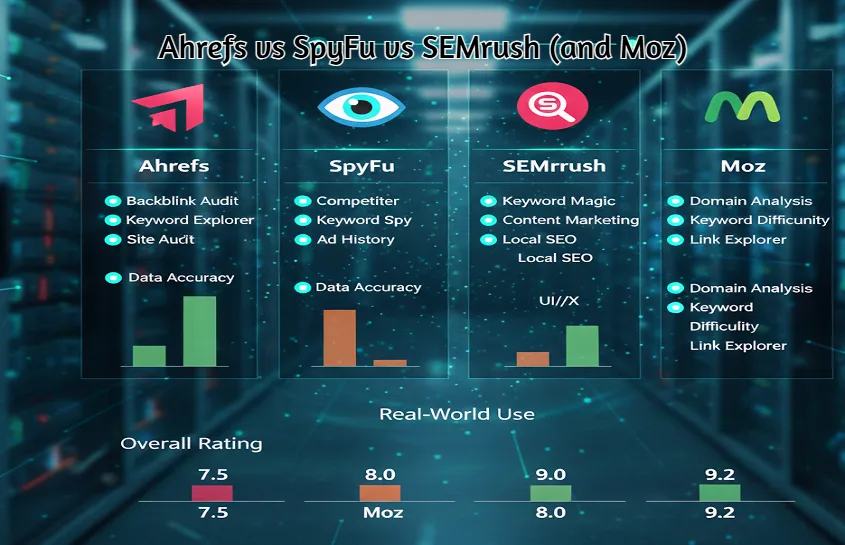
Search engine optimization has matured. What once revolved around a handful of keywords and backlinks now requires competitive intelligence, technical audits, content strategy, and data accuracy at scale. That’s why professional SEO tools matter — not as optional software, but as decision-making systems. Among dozens of platforms available today, Ahrefs, SEMrush, SpyFu, and Moz consistently dominate serious SEO conversations. Each promises better rankings, smarter insights, and stronger competitive advantages. Yet despite surface similarities, these tools are fundamentally different in how they collect data, what they prioritize, and who they’re actually built for.
This article offers a complete, unbiased comparison of Ahrefs vs SpyFu vs SEMrush, with Moz included for context. It’s written for marketers, founders, SEOs, and content strategists who want clarity — not marketing hype.
Understanding the Core Purpose of Each Tool
Before comparing features, it’s important to understand why each tool exists. Most confusion comes from assuming they all solve the same problems.
Ahrefs: Built for SEO Accuracy and Link Intelligence
Ahrefs was built around one core belief: links and search data should be as accurate as possible. Everything in Ahrefs revolves around organic search performance, backlink profiles, and competitor validation. It does fewer things than SEMrush, but the things it does, it does deeply.
Ahrefs is not a “marketing suite.” It’s a professional SEO research tool.
SEMrush: An All-in-One Digital Marketing Platform
SEMrush takes a broader approach. It’s designed to support SEO, PPC, content marketing, competitive research, PR, and reporting under one roof. Instead of specializing in one area, SEMrush aims to give teams a complete operational view of their digital presence.
That breadth is both its greatest strength and its biggest tradeoff.
SpyFu: Competitive Intelligence First, SEO Second
SpyFu was built to answer one question:
“What is my competitor doing — and what’s actually working for them?”
Its strongest features revolve around historical keyword data, paid search insights, and competitor consistency. SpyFu is not trying to be a technical SEO platform. It’s a strategy and intelligence tool.
Moz: Accessibility, Education, and Simplicity
Moz has been around longer than most SEO tools. Its focus has always been on clarity, education, and accessible metrics. Moz doesn’t try to overwhelm users with data. Instead, it simplifies SEO for smaller teams and beginners.
Keyword Research: Data Depth vs Practical Insight
Keyword research is often the first feature users evaluate — and where opinions differ most.
SEMrush: Best for Keyword Discovery and Expansion
SEMrush excels at discovering keyword opportunities at scale. Its keyword tools are designed for content planning, search intent analysis, and topic clustering. You can start with a single keyword and expand into hundreds of related variations, questions, and semantic topics.
This makes SEMrush particularly strong for:
- Editorial teams
- Content-driven websites
- Agencies planning large content calendars
However, the sheer volume of data can sometimes obscure prioritization. SEMrush gives you many options — deciding which ones matter still requires judgment.
Read More: How to Solve Error Establishing a Database Connection Quickly and Safely
Ahrefs: Best for Keyword Validation and Difficulty Accuracy

Ahrefs approaches keyword research differently. Instead of focusing on volume alone, it emphasizes ranking feasibility. Its keyword difficulty metric is widely respected because it’s grounded in backlink analysis rather than abstract scoring.
Ahrefs is ideal when:
- You need to assess ranking difficulty realistically
- You want fewer but more actionable keyword ideas
- You prioritize accuracy over quantity
Many experienced SEOs use Ahrefs to validate keywords discovered elsewhere.
SpyFu: Best for Historical Keyword Intelligence
SpyFu’s unique advantage lies in history. You can see which keywords competitors have consistently ranked for or paid for consistently over time. This helps identify keywords that actually convert — not just those with high search volume.
SpyFu is especially useful for:
- Affiliate marketers
- PPC advertisers
- Niche site builders
It’s less about discovery and more about proof.
Moz: Simple and Beginner-Friendly
Moz’s keyword research tools are straightforward to use, but the database is smaller. It’s best suited for:
- Local SEO
- Small websites
- Beginners learning keyword fundamentals
Backlinks and Authority Analysis: Where Ahrefs Leads
Backlinks remain one of the strongest ranking signals, and this is where Ahrefs clearly separates itself.
Ahrefs: Industry-Leading Backlink Data
Ahrefs maintains one of the largest and most frequently updated backlink indexes available. It provides:
- Detailed link growth and loss tracking
- Clear anchor text analysis
- Accurate referring domain metrics
- Trustworthy link quality indicators
For link building, competitor analysis, and penalty recovery, Ahrefs is often considered the gold standard.
Read More: Prizmatem: Exploring the Meaning, Vision, and Future Behind the Concept
SEMrush: Strong, Integrated, and Agency-Friendly
SEMrush’s backlink tools are robust and improving steadily. While its link index may not be as deep as Ahrefs, it compensates with:
- Integrated outreach tools
- Toxic link identification
- Combined technical audits
For agencies managing multiple clients, SEMrush’s workflow integration can be more efficient.
Moz and SpyFu: Limited Depth
Moz provides backlink data that’s useful for high-level analysis but lacks granularity. SpyFu’s backlink features are minimal and should not be a deciding factor.
Technical SEO & Site Audits
Technical SEO is where many tools claim strength — but execution matters.
SEMrush: Best Overall Technical SEO Suite
SEMrush offers one of the most comprehensive site audit tools available. It covers:
- Crawlability
- Core Web Vitals
- Indexing issues
- Internal linking
- HTTPS and structured data
Reports are detailed and suitable for client delivery, making SEMrush a favorite among agencies and in-house teams.
Ahrefs: Focused and Practical
Ahrefs’ site audit tool is strong, fast, and focused. It highlights critical issues without overwhelming users. While it doesn’t replace a dedicated technical crawler, it’s more than sufficient for most SEO needs.
Moz: Clear but Limited
Moz’s technical audits are easy to understand but lack depth for complex sites. They’re best for smaller websites or SEO beginners.
Competitive Analysis: Organic and Paid Insights
Understanding competitors is where SpyFu and SEMrush shine.
SpyFu: Competitive Intelligence at Its Core
SpyFu allows you to analyze:
- Competitors’ most profitable keywords
- Long-term ranking trends
- Ad copy history
- Paid search consistency
This historical perspective is invaluable for identifying strategies that have stood the test of time.
SEMrush: Broad Competitive Visibility
SEMrush provides competitive insights across:
- Organic search
- Paid search
- Content performance
- Traffic sources
It’s ideal for teams that want a panoramic view rather than deep historical focus.
Ahrefs: Organic Competition Only
Ahrefs excels at organic competitor analysis but offers limited PPC insights. For purely SEO-driven competition, it’s excellent.
Content Strategy & Editorial Planning
SEMrush: Built for Content Teams
SEMrush offers tools for:
- Content gap analysis
- Topic research
- SEO writing guidance
- SERP intent breakdowns
For blogs, SaaS companies, and media sites, SEMrush often becomes the central content planning platform.
Ahrefs: Competitive Content Validation
Ahrefs is excellent for identifying:
- Top-performing competitor content
- Pages earning the most links
- Content gaps based on ranking URLs
It’s more analytical than editorial but extremely effective.
Usability, Learning Curve, and Workflow
- Moz is the easiest to learn
- SpyFu is intuitive and fast
- Ahrefs is clean but assumes SEO knowledge
- SEMrush is powerful but complex
There is no universal “best” interface — only what fits your team’s experience level.
Pricing and Long-Term Value
Price alone is misleading. Value depends on how much of the tool you’ll actually use.
- SEMrush costs more but replaces multiple tools
- Ahrefs is expensive but unmatched for SEO precision
- SpyFu offers strong value at a lower cost
- Moz sits in the middle but delivers less data
Professionals often combine tools rather than relying on one.
Real-World Testing: What Actually Works Best?
In practice:
- Ahrefs is trusted for link audits and competitive SEO
- SEMrush dominates content planning and reporting
- SpyFu reveals competitor intent better than any tool
- Moz supports learning and simpler SEO workflows
No tool wins every category.
Final Verdict: Which SEO Tool Should You Choose?
Choose Ahrefs if:
- SEO accuracy matters more than feature volume
- Backlinks and rankings are your priority
Choose SEMrush if:
- You want a complete marketing ecosystem
- You manage content, PPC, and SEO together
If Choose SpyFu:
- Competitive intelligence drives your strategy
- You want insight without enterprise pricing
Choose Moz if:
- You’re learning SEO
- You prefer clarity over complexity
Closing Thoughts
The Ahrefs vs SpyFu vs SEMrush debate isn’t about which tool is “best.” It’s about fit.
The strongest SEO strategies aren’t built on software alone — they’re built on understanding, experience, and informed decision-making. The right tool simply helps you see the path more clearly.